Thursday, 24 April 2014

Any thought passed to the subconscious well enough is accepted

Keep affirming positive suggestions and outlooks to yourself and this will soon become your normal way of thinking.

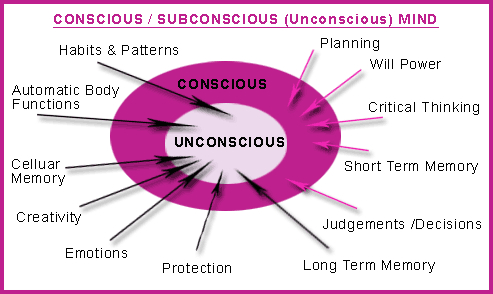
Your mind is your most important thing you have. A well-developed mind is what separates us from animals. It has allowed many people to invent great things and produce great works of art. To get the most out of it you need to understand it better. The mind operates at two levels – the conscious and subconscious, or the rational and irrational. You think with your conscious, rational mind. The subconscious, irrational mind is the creative engine and the seat of emotions. Once the subconscious accepts an idea it begins to act. It treats good and bad ideas the same. If you plant negative ideas in your subconscious mind, you will reap negative outcomes. If you plant positive ideas, you will reap positive outcomes. Robert Collier said in The Law of Higher Potential that any thought that is passed on to the subconscious often enough and convincingly enough is finally accepted.
     You reason with your conscious mind. You choose what you want, your partner, your home. Your subconscious keeps your body running. Your subconscious mind accepts what it is told and acts without reasoning. We have all seen hypnotist shows. People who are susceptible to hypnosis are put into a trance by the hypnotist. The hypnotist is bypassing their conscious mind and talking straight to their subconscious. The subjects are very susceptible to suggestion and will do things in front of a large audience that their conscious mind would never allow them do. Your subconscious mind is suggestible. Think about that man walking on his hands and knees sniffing the chairs because the hypnotist suggested he was a dog. Your subconscious will accept ideas without reason even when they are false.
     The subconscious mind is very susceptible to suggestion. You have to use your conscious mind to protect your subconscious from damaging suggestions. If you are on a ship and you tell a rather unconfident looking passenger that she is not looking too good and that she might get seasick, she probably will. She is already worried. But if you tell an experienced crew member he might get seasick he will laugh at you or tell you to get lost. Your mention of seasickness only reminds him he is immune to it. The conscious mind has the power to reject suggestions.
     There is an old saying, “Be careful what you wish for. You might get it.” Murphy tells a story about a man whose daughter had a terrible skin condition and crippling arthritis. Over and over he said he would give his right arm to see his daughter cured. One day the family was out driving and was involved in a serious car crash. He lost his right arm. When he got back from the hospital he discovered his daughter’s arthritis and skin problem were gone.
     Murphy tells another story about a man who was told by an Indian fortune teller that he would die at the next new moon. He told everybody the terrible prediction. He turned from being a vigorous, healthy individual into an invalid. He died of a heart attack on the appointed day. He accepted the prediction instead of laughing it off. If he had not accepted the suggestion he would not have died.
     You should repeat positive suggestions to your subconscious. If you are fearful or losing your memory or constantly angry, make positive suggestions to yourself. Write a prayer to tell yourself how you want to be. Repeat it several times a day including before you go to sleep and when you wake up. For instance if you are susceptible to angry rages, tell yourself you are getting calmer every day.
     I have a list of improvements I want to make, and things I want to be and do, saved as a note on my iPhone that I read morning and evening and in the middle of the day. Over and over I am suggesting what I want to be and do. This keeps my subconscious on track.
     You need to watch out for suggestions others make, and indeed the suggestions you make to others. From the day you were born you have been bombarded with negative suggestions, about you, about life, about the economy, about diseases, about the weather. As a child you were particularly susceptible, and your children are now. I remember that when I was a child, a man said on a chat show on TV that Chinese people believe that if your nostrils are open you will never be rich: the money will come out your nose. For years after hearing this I believed I could never be rich because I could see into my nostrils in the mirror. This is nonsense, but it does prove how susceptible even intelligent people are to suggestions when they are young.
     You should make positive suggestions to yourself to counter negative suggestions others make. If someone tells you the weather is awful, tell yourself tomorrow will be nice and your lawn needs the rain. If someone tells you the economy is terrible, tell yourself that so-and-so just got a good job so it can’t be all bad. You do not have to accept negative suggestions made by others about you or life in general. And be extra careful of the suggestions you make to your children.
     Watch out for the power of a major premise. If you have a self-destructive major premise, for example you think you will never amount to anything or that no one will ever like you, it makes it very difficult to do anything that contradicts this. You need to change to a positive major premise. You need to catch yourself every time you think your major premise, and change it. Write a prayer with how you would like to be and repeat it over and over until it becomes your new way of thinking.
     Your subconscious mind knows all the answers, but does not know that it knows, and could take time coming up with the answer. You need to keep affirming positive directions and in time you will know the answers. Keep affirming positive suggestions and outlooks to yourself. This will become your normal way of thinking. Choose life. Choose love. Choose health. Choose wealth. Choose happiness.


This is an extract from ‘Improve your life’ by George Nicholas. It is based on ideas of Dr Joseph Murphy from ‘The power of your subconscious mind’.

Thursday, 17 April 2014

There is great potential within you

Take control of your mind. If you change your thoughts you will change your destiny.

There is infinite power available to you: all you have to do is to realize it and use it. A magnetized piece of iron will lift many times its own weight. A demagnetized piece will lift nothing. Likewise a magnetic human personality will attract friends, lovers and wealth. A demagnetized person, full of fear and doubts about people not liking them or losing money, will repel all opportunities. You can control this by controlling your subconscious mind. Once you learn how to control this tremendous power that lies within you, your life can become grander. All it needs is for you to take control. You can attract the right business or life partner and money. Many people have already done so.
     There are a few key principles you need to learn to operate your subconscious mind. The rules for operating it are as set as the laws of physics or chemistry. If you burn hydrogen in oxygen you always get water, H2O: you don’t sometimes get H5O or HO2. Likewise if you let go of a heavy object at the top of a tall building, it always falls to the ground. The law of gravity always applies. The object never hovers or moves up, or sideways.
     Your subconscious mind also follows unvarying laws of nature. It follows the law of belief. Whatever you believe will come to pass within your mind. Everything is the result of your beliefs. Stop accepting false and damaging beliefs. Fill your mind with good things: with thoughts of harmony, health and wealth.
     Think of the human brain as a computer: the most powerful computer ever made. Like any computer it has parts for input and output and parts inside that you don’t see, for processing data. With a computer you input data using the keyboard or a webcam and receive output on the screen, printer or other controlled device. The human brain is the same. Most input from your senses and output to your limbs is controlled by the conscious mind. You input and output data with conscious thought. But the vast bulk of work is carried out by the subconscious mind.
     Just as you never really know what the microprocessor or graphics card is doing in a computer, you are not aware of how your brain is controlling your heart, digestive system or renal system. Your computer can produce tremendous work or garbage, depending on the input. So too can your brain. Computer programmers have a saying for the results of poor programming – “Garbage in, garbage out.” The same principle applies to your brain.
     Think of your subconscious mind as a garden and your conscious mind as a gardener. Your conscious mind plants thoughts in your subconscious mind. The thoughts can be the seeds of fruits or the seeds of weeds. You need to take control of the seeds that you plant. Sow thoughts of peace, happiness and prosperity. Think quietly about the good qualities you want to have. When you learn to control your thought processes you can take control of your life and be able to deal comfortably with any difficulty. Each of the following chapters will give specific illustrations of how to use the power of your subconscious mind to control your life as you would like it.
     Your conscious brain is like the captain of a ship. It orders the subconscious mind to operate the engines. But the people in the engine room don’t know if the ship is on course or headed for rocks. It is up to the captain to give the right orders. If you keep on telling yourself you cannot afford something or you will never attract a mate, you never will. Your subconscious mind will follow orders. But if you tell your mind you will receive it, your subconscious mind will obey. You or nature will find a way to bring it to you.
Never tell yourself you can’t have something or do something you want. If you do, immediately reverse the thought. Tell yourself you can afford it. You can do it.
     The great secret that those who achieved great things in science or the arts possessed was the power to control the mind. Decide now that you want to take control of your mind. Change your thoughts and you will change your destiny. Believe.
     This is an extract from ‘Improve your life’ by George Nicholas. It is based on ideas of Dr Joseph Murphy from ‘The power of your subconscious mind’.

Thursday, 10 April 2014

Smoking

Last week on the radio I listened to a discussion about a government proposal to drastically limit the hours in which cigarettes could be sold and prevent cigarettes being sold in pubs. The justification was to make it harder for casual smokers to buy cigarettes. One of the supporters of the move threw out the comment that if cigarettes were invented today they would never get government approval. It got me thinking about freedom.
     There is nothing you can do that will have a more beneficial effect on your health than giving up smoking. 50% of smokers die younger of smoking related diseases. I used to smoke myself and gave up years ago. Although to be fair I was never a heavy smoker anyway. So why wouldn’t everyone give them up? Perhaps they think that they will be part of the 50% who will not die of a smoking related disease. The longest lived human Jeanne Calment smoked until she was 117. But 50:50 are not great odds.
     If people choose to do something risky that may shorten their lives aren’t they their lives? Shouldn’t it be their choice? Smoking is one of these activities. Many people engage in dangerous jobs and pastimes that could shorten their lives. Some people participate in equestrian sports or motorcycle racing or cliff diving– activities in which the chance of death and injury is high.  I don’t hear of calls for restrictions on these activities.
     So why is there such a campaign to educate smokers out of their habit? Sometimes the cost of treating smoking related diseases is mentioned. But what is never mentioned is that even people who do not smoke die eventually. And the last few weeks of their lives will cost a similar amount in hospital care to smokers. They will die at an older age on average and so will cost more for pensions than smokers. These costs are never mentioned.
     I recall hearing about a company in the late 80s or early 90s which conducted a study of the costs to its health plan of smokers and non-smokers. Surprisingly for the conductors of the study, smokers had lower healthcare costs. This was clearly not the expected result. The motivation for the study was to justify not hiring smokers. The survey did not get that result. So clearly the financial excuse does not stand up to proper financial scrutiny.
     Now it is a cash cow for governments. They can tax tobacco at high levels and justify it by saying they are trying to reduce smoking. It effect it is a very lucrative regressive tax. The do-gooders are comfortable with a tax that is especially heavy on lower income people because it is for their own good.
Another justification is the health of others. However, results of studies on health effect of secondhand smoke do not show convincing links to illnesses. The unpleasant smell on clothes and in the air is justification enough to make sure that non-smokers have smoke free indoor spaces. I fully agree with bans on smoking in certain areas.
     However, I do think that owners of restaurants and bars should be allowed to provide comfortable areas for smokers. This is often not allowed by law demonstrating that a very important secondary objective of laws to provide smoke free areas for non-smokers is to make life uncomfortable for smokers.  
Now that smoking is banned in many indoor and outdoor spaces, secondhand smoke exposure is no longer a good excuse for further restricting banning smoking. The latest idea is to ban smoking in cars with children present. It will only be a short shift to extend this ban to your own home if children are present. Now it is easy to see the emotional case for this – protect the children who have no say. But they are the children of the smokers and it is their duty as parents to bring up their children as well as they can. Perhaps smoking is the thin end of the wedge. Next thing the nanny statists will want to use the law to apply their standards of child rearing in many other areas.  While I would recommend that parents not smoke excessively in front of their children, making it the law seems excessive.
     Laws to restrict the use of illegal drugs have not worked expect for the drug dealers. They get high prices and no legal competition. But prescription medications from middle class doctors are OK, and indeed expected in many cases. It again shows that societal control is a major motivation behind the war on drugs dressed up as a health issue.
     Smoking and drug taking may shorten your life. But it is your life and if you choose to shorten it that is your choice. A number of years ago the law making suicide illegal was reversed. Shouldn’t the same principle apply to smoking? If you choose to shorten your life, it is your life and others should not intervene.

Thursday, 3 April 2014

We just are

As I sat in the church at the funeral of a neighbor yesterday I contemplated life. The man had died at a good age leaving behind a large family of children, grand-children and great-grand-children. I thought that we all come into the world. While we are here we eat to survive, we procreate, we make our lives comfortable, and perhaps we do good works or leave something behind to make the world a better place for people who come after us.
     But why? What is our overall purpose? This question has been asked for millennia by great philosophers, thinkers and religious leaders, and by many of the rest of us as we contemplated life. Animals don't have such worries. My dogs eat, sleep and chase rabbits. They follow instinct to to these things and to mate, to defend themselves and find more comfort. I don't get the impression that they engage in philosophical thought about their raison d'etre. So why do we? We are more intelligent, but most of our actions are about survival, comfort and procreation. Our main priorities are no different from those of other animals. 
     So why do so many of us ask why we are here? Why do so many look for a higher purpose? Why do so many think they should leave a legacy? Other creatures are not plagued by these thoughts. We worry about the future of the planet, even though we won't be here ourselves. We worry that we may not have a life after death. We worry that we will not leave a legacy or be remembered.
     But then it struck me. There is no reason for us to be here - We just are. That is it - "we just are". We evolved from apes who evolved from other mammals to become the most intelligent adaptable creatures on Earth. We have shaped the world and its resources to make our lives better, longer, more comfortable and to allow the world to accommodate more of us. We live from the poles to the tropics and everywhere in between. We make great devices from the resources of the Earth to make our lives better, longer, more comfortable. We produce ever increasing amounts of food to feed ourselves.
     As we achieve what no other creatures have managed we wonder why? For what purpose. But there is no purpose beyond our existence. We are survivors. Everyone of your ancestors survived long enough to procreate. That is an achievement in itself. 
      So if you ever wonder why you are here, you are here because your parents bore you and they are here because their parents had them. There is no purpose. You are the latest generation of the most evolved species on Earth and like the generations before you, you will eat, seek comfort and procreate so another generation will follow. Each new generation will further improve life here on Earth. And for what purpose?
    Because we are.

Thursday, 27 March 2014

Plastic bags at airport security

I recently completed a business trip to Israel. I travelled from Dublin to Tel Aviv and back via Luton. The budget airline combination of Ryanair and Easyjet is one of the most effective ways of travelling from Ireland to Israel and certainly the cheapest.
    My trip did raise questions about airport security. Which of the three airports had the tightest security? Which of the three airports did not ask me to take my small quantities of toiletries out of my suitcase and separately display them?
    If you guessed Tel Aviv had the tightest security you would be right. My fellow passengers in the taxi  from Beersheva and I were quizzed by security at the airport perimeter for many minutes until security was satisfied. Upon arriving at the terminal I was again quizzed by a pleasant young lady about the contents of my bag. All checked luggage was put them through a scanner for inspection before the owners proceeded to check in. There was a lot of technical equipment for explosives detection.
    I then proceeded to boarding card check, passport control and the usual hand baggage screening and walk through a metal detector. Which brings me back the second question. Which airport did not ask me to present my toiletries in a little plastic bag – Security conscious Tel Aviv, Dublin or budget airline Luton? Answer is again Tel Aviv. I did not even have to take off my belt as requested to at Luton and Dublin.
    So why do these airports ask us to go through these inconvenient rituals? If there were a security benefit to separate display of liquids and removal of belt Tel Aviv would surely do it? I can understand the 100 ml limit on liquid sizes and the overall 1 litre bag, but what benefit is it to ask us to put these items in a separate plastic bag outside of our hand luggage? I can’t think of one. Or why take off a belt? What dangerous item can be concealed under a belt that will not set off the metal detector we walk through anyway? Do these rituals provide any useful security benefit?
    Perhaps Tel Aviv security is smarter because it is worried about real threats. Security concentrates on passenger screening. This provides much more benefit that inconveniencing everyone. In Dublin security had the added threat that if you failed to take the liquids out of your bag they would throw them away. Luton just delayed me by taking bag of toiletries out and sending it and bag through again and telling me it would be quicker if I took it out in the first place- an inconvenience but not as bad as Dublin’s threat.
    People are security conscious and comply with willingly with sensible preventative measures. However, it is difficult to see the security benefit of taking out the bag. I remember Dublin was not as strict on this a year or two ago. If Tel Aviv can dispense with this security procedure surely Dublin and Luton can?

Thursday, 20 March 2014

Give it away now

“Give it away give it away give it away now 
Give it away give it away give it away now 
I can't tell if I'm a king pin or a pauper”
     Whether you are a king pin or a pauper you will have a much better life if the take the advice of the Red Hot Chili peppers and give it away. True happiness and success in life comes from giving. The young singer Janelle Monae said ‘I'm a believer that the more I'm giving, the happier I am, and the more beautiful my exterior will be.’
     The importance of giving has been studied since earliest times. One of the greatest works by Roman stoic philosopher Lucius Annaeus Seneca is called on Benefits. In this great moral work of 7 books Seneca describes correct and incorrect etiquette of giving and receiving gifts. He complains that one of the biggest problems in life is that so few people know how to give or receive gifts properly.
     Much of Seneca’s advice on giving and receiving gifts is still applicable 2,000 years later. You should generously give gifts that are useful and needed to those who appreciate them. You should give without having to be asked. You should give and receive with a good attitude. You should not expect to receive back exactly what you give – a gift is not a loan. 
     On the other hand you should return the generosity of those who give to you if and when and as much as you can. Even a pauper can be grateful to a king. Seneca’s key message is that it is important to give and receive well.
     The most famous giver of the middle ages was St Francis of Assisi. He said ‘For it is in giving that we receive’. Son of a wealthy merchant he famously gave all his possessions to the poor and dir charitable works. His holiness and giving nature was recognised by the pope and influential cardinals and even by the Sultan of Egypt who he visited on a peace mission in that time of the Crusades. Pope Gregory IX canonised him just 2 years after his death. The current pontiff showed that this great giver has a message relevant today by taking the name Francis. 
     Even modern spiritualists recognise the importance of giving. Maya Angelou said ‘that among its other benefits, giving liberates the soul of the giver’
     And you can prosper by giving. A recent book, a business parable called The go-giver by Bub Burg and John David Mann tells how. The trade secret of success is giving. In the tale the authors through the main tutor Pindar and a number of others, teach young Joe important lessons of giving.
     Firstly The Law of Value: Your true worth is determined by how much more you give in value than you take in payment. We all love a bargain. We all like to get good value. But are you a bargain? I’m not asking if you’re cheap! But being good value is one of keys to achieving success. If you give much more in value that you take in payment you have high worth. 
     Next, The Law of Authenticity: The most valuable gift you have to offer is yourself. When you give, give yourself. Give gifts that suit your character. Don’t try to be someone else. 
     Finally, the Law of Receptivity: The key to effective giving is to stay open to receiving. In order for the giving circle to be closed you have to allow others give as well. Did you ever hear that it is better to give than to receive? Do you believe it?  It may be better to be able to give than to have to receive. But if you give everything and take nothing, you might starve to death!  Even St Francis begged for alms. If you think it better to give than to receive you do not give others the opportunity to give. And you receive fewer things to give to others.
     Picture a time you were in a pub, the smell of beer, the sound of laughter. Your colleague bought you a drink earlier and it’s your round? “So what are you having?” – “No, no, no! I’ve to get up early tomorrow”… “ah go on, go on”. You end up begging to buy a drink. You’d nearly prefer not to go out with him again. He is as bad as the guy who sneaks off to the toilet when it is his round! That giver is not giving you the opportunity to give back and is blocking the system.
     It is important that you are open to receiving as well as giving. This is one way you benefit from your generosity.
     You should think about what you can give to people. What can you give to your family, your friends, your co-workers, your community.  As well as gifts give your time, experience and love. 
     I am much happier since I learned to give more. 
    Giving is indeed the secret of success in life. I end with the insightful words of Anne Frank, who gave us so much in her short life.  ‘No one has ever become poor by giving’

Tuesday, 5 November 2013

Beauty and the uncannily evil monster

What do the writers Ernest Hemingway, Charles Dickens, and Stephen Fry; the singers Frank Sinatra, Sinéad O’Connor, and Kerry Katona; the actresses Catherine Zeta-Jones, Marilyn Monroe and Vivien Leigh all have in common? There are all intimately acquainted with what Laurence Olivier called the uncannily evil monster – manic depression – bipolar disorder. Daniel Goleman describes bipolar disorder as a cycle of paralyzing depressions alternating with manic episodes that mix chaotic elation with grandiosity, with irritation and rage. Like Olivier I am personally acquainted with this monster.

Today on the centenary of her birth I would like to remember a great actress. Vivian Mary Hartly was born on 5th of November, 1913 in Darjeeling, India. Her father Ernest Hartly was a British cavalry officer. Her mother Gertrude Mary Frances (Née Yackgee) a half Irish, half Bengali catholic. Vivien was raised catholic and her mother also instilled in her a great love of stories. She even had her perform on a stage at age 3. At age 6 she was sent to a convent boarding school in England and one of her friends there was Maureen O’Sullivan. She told Maureen she would be a great actress. At age 14 her father took her out of school and she travelled Europe with him.

At age 18 she returned to London and enrolled in the Royal Academy of Dramatic Arts to train to be an actress. Soon after she saw barrister Herbert Leigh Holman, 15 years her senior, riding a horse and decided she would marry him. In 1932 she married Leigh Holman and 10 months later their daughter Suzanne was born. She had given up RADA when marrying but soon started to take on small roles in movies and plays. Her agent was not happy with the name Vivian Holman and wanted her to call herself April Morn. She didn’t but he was happy when she took her husband’s middle name and changed the spelling of Vivian to use an e to distinguish her name as female.

She got bigger and bigger roles in plays and was soon introduced to Laurence Olivier. They played lovers in the play ‘Fire over England’ in 1937 and during its run became lovers. They moved in together but their respective spouses refused divorces at the time. He saw a glimpse on the monster when she played Oephelia to his Hamlet in Elsinore, Denmark. She had a major mood swing but they patched things up.

While recovering from a leg injury at that time she read the Margaret Mitchell novel ‘Gone with the Wind’. She was determined to play Scarlet O’Hara in the upcoming David O. Selznick production. It so happened that Olivier’s agent in America was Myron, Selznick’s brother and he worked to get her the role. He brought her to the filming of the first scene – the burning of Atlanta – the burning of some old sets at MGM in Hollywood and she was introduced to Selznick and got the role. She worked very hard at it and was duly rewarded with the best actress oscar. She was now a big star.

In 1940 Vivien married Laurence Olivier after Jill Esmonde agreed to divorce Olivier and Holman agreed to divorce her. Jill got custody of Olivier’s son, Tarquin and Holman custody of Suzanne. She worked a lot in the 40’s with and without Larry. After a miscarriage in 1945 she became profoundly depressed. There were now frequent rows between the two. On a tour of Australia and New Zealand in 1948 they had frequent disputes. She refused to go on stage in Christchurch and he slapped her and she hit him back. She was also sexually insatiable at the time and he could not satisfy her. She frequently propositioned delivery men and others. Larry was a bit relieved when she started an affair with actor Peter Finch.

She soon started work on her other great role, again as a southern belle. For 9 months she played Blanche Dubois in the Tennessee Williams play, ‘A Streetcar named Desire’. She acted in the movie with costar, Marlon Brando. She won her second academy award, but the role was difficult. Playing a mentally unstable character tipped her into madness. Throughout the 50’s she worked on often with Olivier. However, the moods of anger or depression were becoming more frequent. Her affair with Peter Finch ended. Larry could no longer manage her. Her ex-husband, Leigh Holman, often moved in to help smooth things. In 1958 she met actor Jack Merivale. He was aware of her condition and told Olivier he would look after her. She lived with him until the end of her life. Olivier remarried Joan Plowright in 1960.

On the 7th of July, 1967 Vivien Leigh died in her home in London of tuberculosis. Olivier helped with the funeral arrangements. He said of her

 “I shall never love anybody as much as Vivien but it isn't possible to live with her and do my work. I just can't keep it up. She's too exhausting for me.”

“Throughout her possession by that uncannily evil monster, manic depression, with its deadly ever-tightening spirals, she retained her own individual canniness – an ability to disguise her true mental condition from almost all except me, for whom she could hardly be expected to take the trouble.”


Today on the centenary of her birth please all think about Vivien and her family. Please also think of the millions of others and their families who have to deal everyday with the uncannily evil monster, manic depression, bipolar disorder.